
Meta has officially unveiled the Ray-Ban Display, the company’s first pair of smart glasses with a built-in digital display designed for consumers. Announced at Meta Connect 2025, the new device marks an important milestone in Meta’s push to move beyond smartphones and create a world where wearables like glasses and headsets replace traditional mobile devices.
Priced at $799, the Meta Ray-Ban Display goes on sale in the United States starting September 30, 2025. International rollout is expected in early 2026. While Meta has been experimenting with smart glasses for years—most notably the camera-equipped Ray-Ban Stories and the prototype Orion glasses—this is the first time a consumer-ready model comes with a functional built-in screen.
Design and Display: What Sets Them Apart
Unlike the bulky Orion prototype showcased in 2024, which required a separate computing puck and was limited to developer demos, the Ray-Ban Display is designed as an everyday accessory.
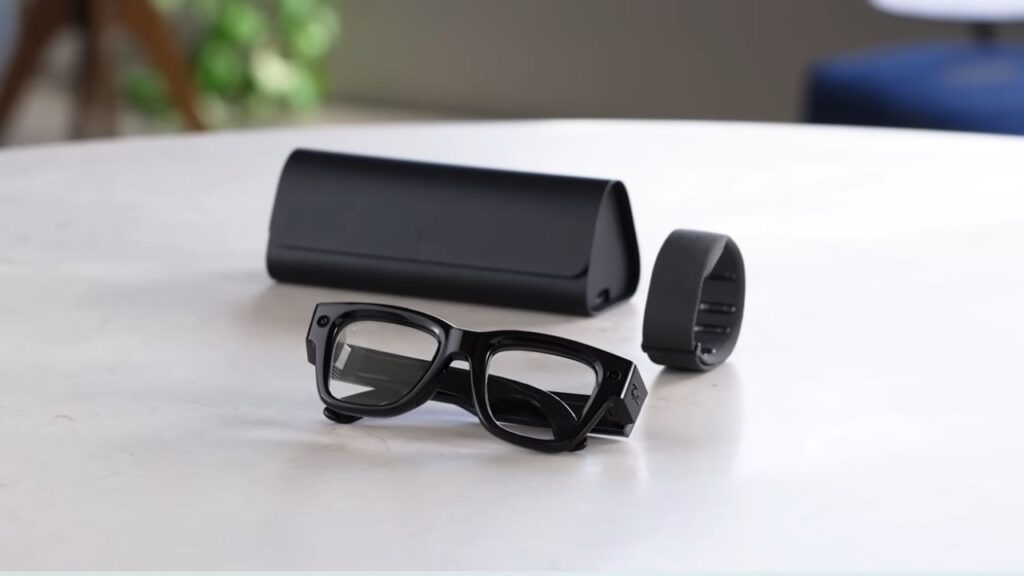
- The glasses feature a slim yet slightly heavier frame compared to regular Ray-Bans, weighing around 69 grams.
- A miniaturized, high-resolution display is built into the right lens, appearing as a translucent overlay that doesn’t block your view of the world.
- The display is optimized for quick, glanceable tasks rather than extended AR sessions.
When worn, the display appears just below the center of your vision, similar to a tiny floating smartphone screen. It can show messages, navigation cues, music details, photo previews, and live captions. While the visuals are clear, reviewers noted that text and icons can sometimes appear slightly murky when contrasted against the real world, a challenge common in early-generation AR displays.
The Neural Band: A Wristband That Feels Like the Future
One of the most striking aspects of the Ray-Ban Display is not the glasses themselves, but the Neural Band wristband.
- The band uses EMG (electromyography) sensors to detect tiny electrical signals from your muscles.
- By interpreting these signals, the band allows you to control the glasses with subtle hand gestures.
- Putting it on feels similar to strapping on a smartwatch, though users reported a mild, static-like jolt when the sensors activated.
Gestures include:
- Pinch with thumb and index finger → open apps or select items.
- Swipe thumb along the side of the index finger → scroll through menus, similar to using a touchpad.
- Pinch and rotate fingers → adjust volume or zoom, much like turning an invisible knob.
For many testers, the Neural Band was the most delightful and futuristic element, demonstrating how far neural interface technology has come in consumer electronics.
Everyday Use: Notifications, Captions, and More
The Ray-Ban Display is designed for practical, quick interactions, not for full immersion. Among its most useful features:
- Messages & Notifications: Texts, WhatsApp messages, and Instagram updates can be read instantly on the lens.
- Live Captions & Translation: Conversations appear as text captions in real time. This feature is especially helpful in noisy environments or for people with hearing difficulties. The system also supports live language translation, making it useful for international travelers.
- Navigation: Walking or driving directions can appear directly in the lens, showing arrows and street names without needing to pull out your phone.
- Camera Preview: The display doubles as a viewfinder for the glasses’ built-in camera, allowing you to frame shots and record video hands-free.
- Music & Media: Paired with apps like Spotify, the display shows track details, while the Neural Band lets you control volume and playback with subtle gestures.
A Mixed Reality Experience: Fun and Challenges
While the experience is exciting, early testers noticed challenges:
- Gesture Learning Curve: Some hand movements, especially pinching, require practice. Testers often had to repeat actions before apps opened consistently.
- Visual Discomfort: Because the display sits off-center in one eye, users occasionally felt cognitive dissonance, with their eyes struggling to adjust focus between the digital overlay and the real world.
- Bulkier Frame: Though stylish, the glasses are heavier than standard Ray-Bans, and it’s clear they house advanced electronics.
Still, the ability to scroll apps with a finger swipe or adjust music volume with a pinch and twist left many feeling like they were living in a scene from a sci-fi movie.
Meta AI Integration
The Ray-Ban Display also includes support for Meta AI, the company’s voice assistant. Users can:
- Ask the AI to identify artworks, objects, or landmarks.
- Use voice commands to open apps, send messages, or take photos.
- Access contextual information without needing to reach for a phone.
During demos, however, activation was inconsistent—reminding us that AI voice control still faces reliability challenges.
Specs, Battery, and Practical Details
- Battery Life: Around 6 hours of active use, with the charging case providing an additional 24 hours.
- Neural Band Battery: Lasts up to 18 hours, is lightweight, and is rated IPX7 water-resistant.
- Camera: Captures photos and videos with stabilization, viewable both on the glasses and through the paired smartphone app.
- Audio: Built-in directional speakers provide open-ear audio, letting you hear music and calls without blocking outside sounds.
Who Are They For?
At $799, the Ray-Ban Display glasses are not mass-market yet. They are clearly aimed at:
- Early adopters who want to try the cutting edge of wearable computing.
- Developers, who can begin building apps for the new display ecosystem.
- Professionals and travelers, who will benefit from live captions, translations, and navigation.
While not perfect, the device represents a critical stepping stone toward Meta’s long-term goal of replacing smartphones with lightweight AR wearables.
The Bigger Picture: Why This Matters
Meta’s investment in AR glasses shows that the company is betting heavily on ambient, hands-free computing. Just as the smartphone reshaped daily life, Meta hopes glasses like these will become everyday companions, offering a seamless mix of digital information and the real world.
For now, the Ray-Ban Display is less about entertainment and more about utility—a smart notification hub, a translator, a captioning device, and a personal assistant. With further refinements in weight, battery, and dual-eye display technology, the glasses could evolve into something far more powerful.
The Information is Collected from The Verge and CNBC.