The professional world moves fast, and by 2026, the old ways of networking are basically ancient history. If you are still treating your page like a static resume, you are invisible to the people who matter. Recruiters and clients now rely on high-tech filters and AI-driven matching to find talent.
To win, you have to understand how to build a linkedin profile 2026 that appeals to both human eyes and the sophisticated algorithms running the show. It is not just about having a job title anymore; it is about proving your value through data and authentic storytelling.
The 2026 LinkedIn Landscape: What Has Changed?
The platform has shifted from a social network to a merit-based marketplace where competence is tracked in real-time. In 2026, your reach is determined by how much people trust your expertise, not how many connections you have. The “spray and pray” method of sending out generic invites is dead because the system now prioritizes meaningful interactions over vanity metrics. You need to position yourself as a thought leader who consistently provides value to a specific niche.
|
Feature |
2024 Standards |
2026 Reality |
|
Primary Metric |
Likes and Comments |
Saves and Private Shares |
|
Algorithm |
Engagement-based |
360Brew (Context-aware) |
|
Verification |
Blue checkmark (ID) |
Skill-based verification badges |
|
Search Focus |
Keywords in title |
Project-based outcome data |
|
Content Priority |
Text-heavy posts |
Short-form video and Newsletters |
The Introduction of the 360Brew AI Algorithm
The biggest change is 360Brew, the new AI engine that decides who sees your content and profile. Unlike the old algorithms that looked for quick engagement, 360Brew reads the “depth” of your profile to see if you actually know what you are talking about. If you post about software architecture but your profile lacks technical certifications or project history, the AI will limit your visibility. It looks for a perfect match between your stated skills and the content you share. This means your profile acts as a primary credibility signal that powers your organic reach across the entire ecosystem.
Why Saves and Sends Outperform Likes and Comments
In 2026, a “like” is worth almost nothing in the eyes of the algorithm. The system now looks for “high-intent” signals. When a user saves your post, it tells LinkedIn that your content is a resource worth coming back to later. When someone sends your post to a colleague via DM, it signals that your expertise is worth sharing in a professional capacity. To make your linkedin profile 2026 stand out, you must create content that is “bookmarkable.” Think of tutorials, deep-dive industry reports, or unique frameworks that people cannot find anywhere else.
Foundational Elements of a Winning linkedin profile 2026
Your profile is your digital headquarters, and it needs to be optimized for conversion. When a recruiter lands on your page, you have about three seconds to convince them you are the solution to their problem. This requires a mix of strategic keyword placement and a voice that sounds like a real person, not a corporate robot. Every section of your profile should work together to tell a cohesive story about your professional journey and the results you deliver.
|
Section |
Old Strategy |
2026 Best Practice |
|
Headline |
Job Title at Company |
Title + Value Proposition + Keywords |
|
About |
3rd person bio |
1st person conversational story |
|
Visuals |
Basic headshot |
Brand-aligned banner + HD video intro |
|
Experience |
List of duties |
Quantifiable results and tool-tagging |
Crafting a Search-Optimized Headline
Your headline is the most important piece of SEO real estate on your page. Gone are the days of using “Aspiring Leader” or “Growth Hacker” as a catch-all. Instead, you need a headline that balances human readability with search intent. Use the formula: [Specific Role] + [Main Benefit/Result] + [Primary Tool or Skill]. For example, “Senior Product Manager ~ Helping FinTech Startups scale to 1M users using Agile and AI-driven Analytics.” This tells the algorithm exactly where to place you while showing a human exactly what you do.
Writing a Human-Centric About Section
Please stop writing your About section in the third person. It feels cold and outdated. In 2026, people want to work with humans they like and trust. Talk about why you do what you do. Share a specific challenge you faced and how you solved it. Use a conversational tone, include contractions, and keep your sentences short. Mention your hobbies or interests briefly to add flavor. The goal is to make the reader feel like they already know you before they even send a message.
Visual Branding: Profile Picture and Background Banner
Your visuals need to be crisp and intentional. A high-quality profile picture is non-negotiable, but your banner is where you can really shine. Use the banner to display a call to action or a visual representation of your work. If you are a designer, show a snippet of your portfolio. If you are a speaker, show yourself on stage. Most people leave the default background, so having a custom, professional banner immediately puts you in the top 5% of users.
Read Also: How to See Who Viewed Your LinkedIn Profile Anonymously
The Rise of Verified Skills and the Skills-First Hiring Trend
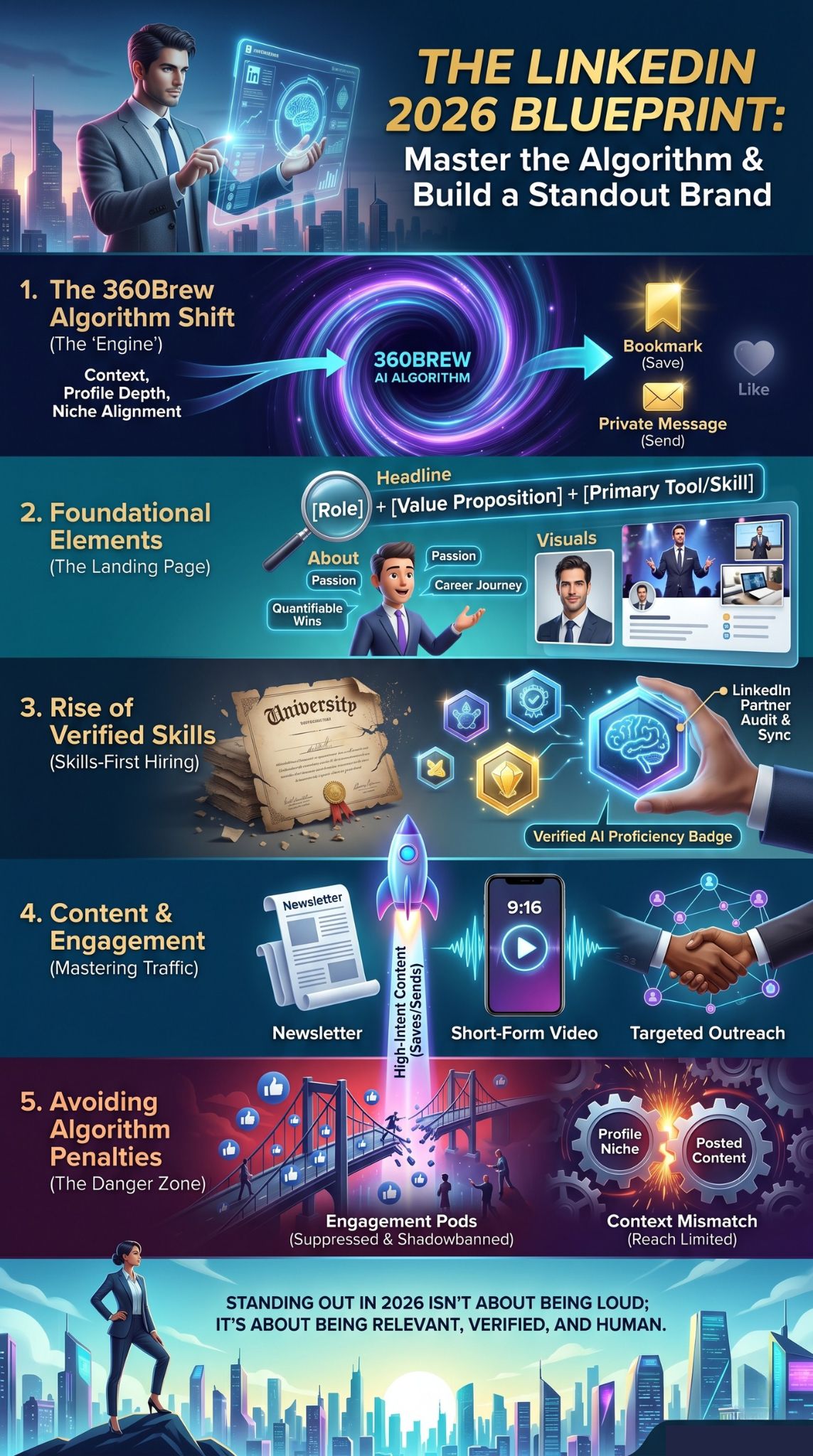
Degrees are taking a backseat to actual, verifiable proof of work. Companies are now hiring based on what you can do today, not what you studied ten years ago. LinkedIn has leaned into this by allowing external tools to verify your proficiency directly on your page. This shift has turned the “Skills” section from a forgotten list into a high-stakes verification hub.
|
Category |
Type of Verification |
Impact on Ranking |
|
Technical |
GitHub / Lovable integration |
High (Direct proof) |
|
Creative |
Portfolio / Descript verification |
Medium-High |
|
Management |
Peer-endorsed project outcomes |
Medium |
|
General |
Standard LinkedIn skill quizzes |
Low |
Showcasing Verified AI Proficiency
AI is no longer a “nice to have” skill; it is the baseline. To make your linkedin profile 2026 truly pop, you should use the platform’s new verification integrations. Tools like Lovable or Replit now sync with LinkedIn to prove you have actually built projects using AI agents. When a recruiter sees a “Verified by Lovable” badge next to your AI Engineering skill, it removes all doubt about your capabilities. This level of proof is worth more than a dozen recommendations from colleagues.
Moving Beyond Traditional Degrees
The 2026 job market values “micro-credentials” and continuous learning. If you took a three-month intensive course on prompt engineering or sustainable supply chain management, highlight it. Link these certifications directly to the “Experience” section. When you list a previous job, tag the specific skills you used there. This creates a data map that recruiters use to filter for specific combinations of expertise, such as “Marketing Manager” + “Python Data Analysis.”
Mastering Content and Engagement on LinkedIn in 2026
You cannot just build a profile and wait for the phone to ring. You have to stay active in the feed. However, the type of activity that works has changed. The algorithm now favors creators who build communities and provide consistent, educational value. Engaging with others is just as important as posting your own updates, as it builds the “relational data” that keeps you visible.
|
Content Type |
Best Usage |
Frequency |
|
Newsletters |
Deep-dive industry analysis |
Once a week |
|
Short Video |
Quick tips and behind-the-scenes |
2-3 times a week |
|
Text Posts |
Contrarian opinions or stories |
Daily |
|
Direct Messages |
High-value networking |
5-10 per week |
Leveraging the Boom of LinkedIn Newsletters
Newsletters are the king of long-form content right now. They allow you to own your audience without worrying about the daily algorithm fluctuations. When you start a newsletter, your connections get a notification to subscribe, giving you a huge initial boost. Use your newsletter to tackle complex topics in your industry. If you are a leader in the green energy space, write about the newest trends in lithium-ion alternatives. This builds your authority and gives people a reason to visit your profile regularly.
Short-Form Video and Authentic Storytelling
Video is the best way to build a “human” connection quickly. In 2026, short vertical videos are prioritized in the feed. Do not worry about being perfect. A raw, thirty-second clip of you explaining a recent project win or a mistake you made is much more engaging than a polished corporate ad. It shows your personality, your communication style, and your energy. These are the “soft skills” that recruiters are looking for but cannot see in a text-based resume.
The Importance of Targeted One-on-One Outreach
Social media is meant to be social. If you find someone interesting, send them a message. But avoid the “Hi, how are you?” trap. Instead, be specific. Mention a post they wrote or a project their company just launched. Offer a piece of value or ask a smart question. These one-on-one interactions are the secret sauce of a linkedin profile 2026. When you interact privately, the algorithm assumes you are close and will show your content to each other more often.
Avoiding the New Algorithm Penalties
As the AI gets smarter, it gets better at spotting “cheaters.” There are several common tactics that used to work but will now get your account shadowbanned or suppressed. Staying on the good side of the algorithm is about being genuine and avoiding shortcuts.
|
Penalty Type |
Cause |
Result |
|
Reach Suppression |
Using engagement pods |
70% drop in visibility |
|
Ghosting |
Inconsistent posting / Inactive profile |
Profile buried in search |
|
Spam Filter |
Sending identical DMs to many people |
Temporary account lock |
|
Context Mismatch |
Posting outside of your verified niche |
Lower ranking in search |
The End of Engagement Pods and Artificial Growth
Using “pods” where people agree to like each other’s posts is a fast track to failure in 2026. The 360Brew AI recognizes these patterns instantly. If the same group of twenty people always likes your post within five minutes, the system marks it as “manufactured engagement.” Once you are flagged, your content will only be shown to those twenty people and no one else. It is much better to have ten genuine likes from industry leaders than five hundred fake likes from a pod.
Aligning Your Profile with Your Content Niche
Consistency is your best friend. If your profile says you are a Finance Expert, but you spend all week posting about your cat or your weekend hikes, the algorithm gets confused. It does not know who to show your profile to. While a little personal flair is great, eighty percent of your activity should align with your professional niche. This helps the AI categorize you accurately so that you show up when someone searches for experts in your field.
Final Thoughts
Standing out on LinkedIn today is not about being the loudest person in the room; it is about being the most relevant. Focus on building a profile that proves your skills through verification and human stories. Treat the algorithm like a partner by providing high-quality, “saveable” content that truly helps your peers. The professional landscape will keep changing, but those who focus on authenticity and verifiable data will always find themselves at the top of the search results. Take the time to audit your page, remove the fluff, and start building your brand for the future.
Frequently Asked Questions (FAQs)
How does the 360Brew AI specifically judge my expertise?
It cross-references your profile’s job history, the skills you have tagged, and the keywords in your posts. If these three areas align, the AI grants you “topical authority,” which boosts your reach when you talk about those specific subjects.
Can I still use AI tools to write my LinkedIn content?
Yes, but you have to be careful. If your content looks like a generic AI output, users will scroll past it and the algorithm will note the low “dwell time.” Use AI to outline or brainstorm, but always rewrite the final version in your own voice to ensure it sounds human.
What is the “Social Selling Index” and does it still matter?
The SSI was a popular metric in the early 2020s, but by 2026, it has been replaced by the “Trust and Relevance Score.” This new internal metric focuses more on the quality of your connections and how many people actually engage with your direct advice.
Is it better to have a public or private profile in 2026?
Always public. To rank for your focused keyword, the search engines need to be able to crawl your data. A private profile acts as a barrier to discovery for both recruiters and potential clients.
How do I handle a career pivot on my profile without losing reach?
Update your About section first to explain the “why” behind the pivot. Gradually start sharing content in your new niche while keeping some links to your old expertise. The 360Brew AI will take about 30 to 60 days to re-categorize your profile.