
Wireless earbuds under $100 used to come with a warning label in your head. You expected okay sound, weak microphones, short battery life, and noise cancellation that sounded better on the box than in real life.
That’s not the case anymore.
In 2026, the best earbuds under 100 can handle daily music, podcasts, calls, workouts, travel, and video streaming without feeling like a bad compromise. You can now get active noise cancellation, app-based EQ, multipoint pairing, water resistance, fast charging, and solid battery life at a price that still feels reasonable.
Of course, not every pair deserves your money. Some brands shout about huge battery numbers or “Hi-Res Audio” but hide the fine print. Battery life often drops when ANC is on. High-quality codecs only help when your phone supports them. And ANC depends a lot on how well the earbuds fit your ears.
So this guide keeps things simple. These are the best wireless earbuds under $100 in 2026, broken down by real use, not just shiny specs.
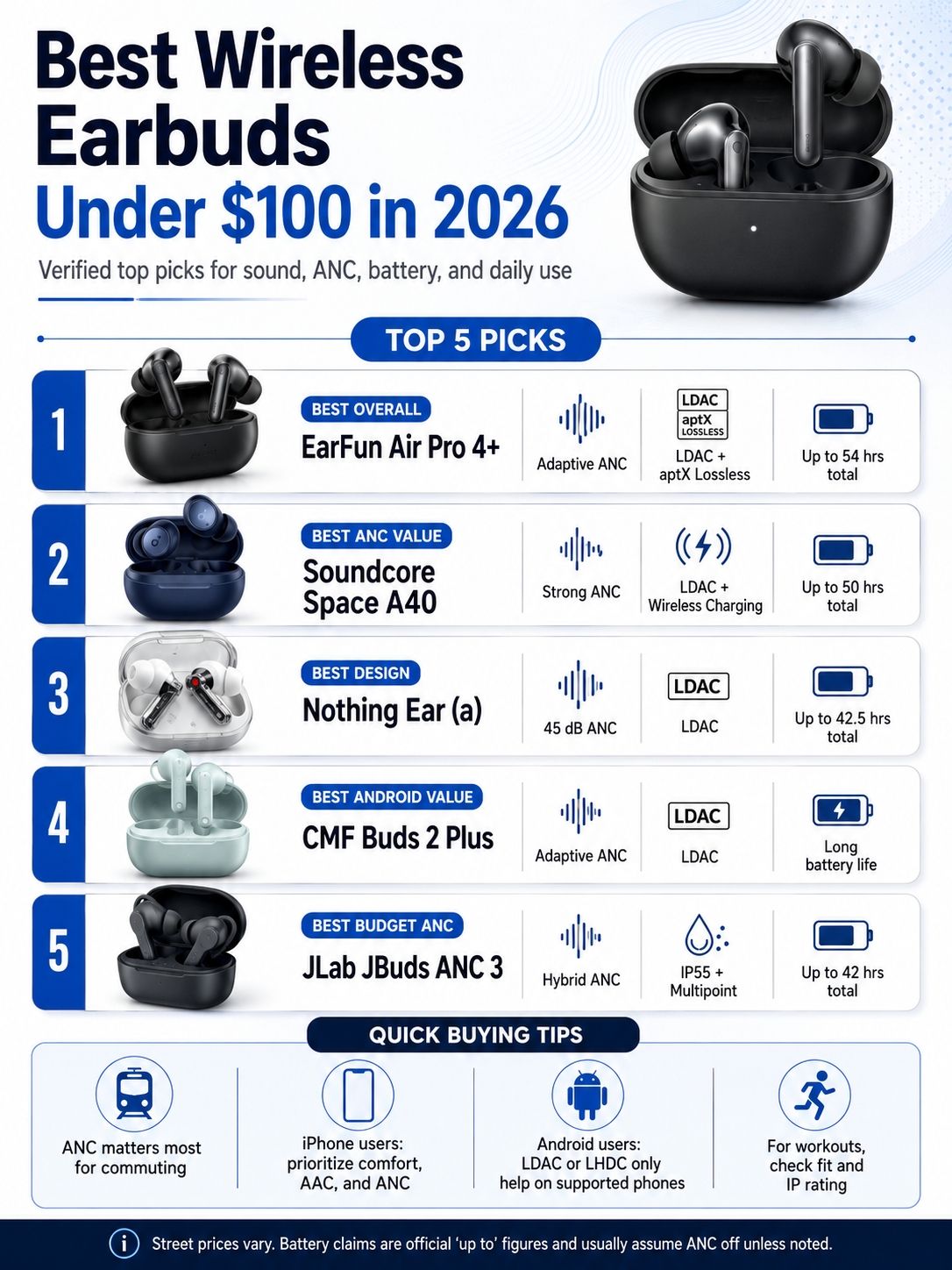
Best Earbuds Under 100: Quick Picks for 2026
Need the fast answer? Start here.
|
Earbuds |
Best For |
Biggest Strength |
Main Drawback |
|
Soundcore Space A40 |
Best tested ANC value |
Strong ANC, small fit, LDAC, wireless charging |
Call quality is only okay |
|
EarFun Air Pro 4+ |
Best feature-packed pick |
Bluetooth 6.0, LDAC, aptX Lossless, ANC, IP55 |
Battery drops with ANC and hi-res codecs |
|
Nothing Ear (a) |
Best stylish pick |
Clean design, LDAC, ANC, dual connection |
No wireless charging |
|
CMF Buds 2 Plus |
Best Android value |
LDAC, strong battery claim, low price |
Less useful for iPhone users |
|
OnePlus Buds 3 |
Best bass pick |
Punchy sound, LHDC, strong ANC, fast charging |
Best features favor Android and OnePlus phones |
|
JLab JBuds ANC 3 |
Best cheap ANC option |
Low price, IP55, multipoint, app support |
ANC is helpful, not premium |
|
Samsung Galaxy Buds FE |
Best for Samsung users |
Secure fit, ANC, Galaxy features |
Not ideal outside Samsung devices |
|
Sony WF-C510 |
Best simple no-ANC pair |
Light, comfy, multipoint, Sony app |
No active noise cancellation |
If you want the safest tested pick, go with Soundcore Space A40. It’s comfortable, reliable, and great for daily noise blocking.
If you want the most features for the money, pick EarFun Air Pro 4+. It gives you a long spec sheet without crossing the $100 line.
If you care about looks, Nothing Ear (a) feels more stylish than most budget earbuds. If you use Android, CMF Buds 2 Plus and OnePlus Buds 3 deserve a close look.
How We Checked These Picks
Budget earbuds can look amazing on paper. That doesn’t always mean they’re good in real life.
So the picks here were checked against official product pages, trusted audio review sites, battery claims, codec support, ANC features, water-resistance ratings, and phone compatibility.
|
What Was Checked |
Why It Matters |
|
Price range |
Some earbuds stay under $100, while others only drop below $100 during sales |
|
Official specs |
Battery, ANC, codecs, water resistance, and Bluetooth features need confirmation |
|
Trusted reviews |
Lab tests and real reviews help separate hype from reality |
|
Phone compatibility |
Android and iPhone users don’t get the same codec benefits |
|
Daily value |
A good earbud should match real use, not just look good on a spec sheet |
A few things need clear wording.
First, some earbuds on this list may sit slightly above $100 at full retail price but often drop below $100 during sales. Always check the current price before buying.
Second, battery life claims need context. “Up to 50 hours” usually means total playback with the charging case, ANC turned off, medium volume, and a basic codec like AAC or SBC. Turn on ANC or LDAC, and the number drops.
Third, codec support is not equal for everyone. LDAC, LHDC, and aptX matter more for compatible Android phones. iPhone users should focus more on comfort, tuning, ANC, microphone quality, and AAC performance.
Why Budget Wireless Earbuds Are Much Better in 2026
The under-$100 earbud market is crowded now, and that’s good news for buyers.
Brands like Soundcore, EarFun, Nothing, CMF, JLab, OnePlus, Sony, and Samsung are fighting hard in this space. That competition has pushed better features into cheaper models.
|
2026 Earbud Trend |
What It Means for You |
|
Better ANC under $100 |
You can reduce fans, traffic, AC noise, and bus engines without paying premium prices |
|
Longer battery life |
Many models now offer 30 to 50+ hours with the case |
|
Better apps |
You can adjust EQ, touch controls, ANC, and firmware settings |
|
More Android codecs |
LDAC, LHDC, aptX, LC3, and Auracast are appearing in cheaper earbuds |
|
More multipoint support |
You can switch between phone and laptop more easily |
|
Better water resistance |
IPX4 and IP55 ratings are now common |
This doesn’t mean budget earbuds beat Bose, Sony’s premium WF-1000 series, or AirPods Pro. They usually don’t.
But most people don’t need $250 earbuds for daily listening. A good pair under $100 can be more than enough for music, podcasts, calls, gym sessions, study time, and commuting.
The trick is choosing the right pair for your phone and lifestyle.
What to Look for Before Buying Earbuds Under $100
Don’t buy earbuds just because the box says “deep bass” or “50 dB ANC.” Those claims can help, but they don’t tell the whole story.
|
Feature |
Why It Matters |
What to Look For Under $100 |
|
Active noise cancellation |
Helps with travel, work, and commuting |
Hybrid or adaptive ANC |
|
Battery life |
Decides how often you charge |
6+ hours per charge, 25+ hours total |
|
App support |
Lets you tune sound and controls |
EQ, ANC modes, firmware updates |
|
Bluetooth codec |
Can improve sound on supported phones |
AAC for iPhone, LDAC/LHDC/aptX for Android |
|
Water resistance |
Helps with sweat and light rain |
IPX4 minimum, IP55 better |
|
Multipoint |
Connects two devices at once |
Great for phone and laptop users |
|
Microphones |
Affects calls and meetings |
Multiple mics with noise reduction |
|
Fit |
Controls bass, comfort, and ANC |
Multiple ear tip sizes |
Fit matters more than most people think.
A loose earbud can ruin bass. It can also make ANC feel weak. A budget pair with a good seal can sound better than a more expensive pair that doesn’t fit your ears.
Also, don’t chase driver size alone. A bigger driver doesn’t always mean better sound. Tuning, app EQ, ear tips, and codec support matter too.
Best Earbuds Under 100: Detailed Reviews
Here’s where each pair stands out.
|
Earbud |
Best Label |
Best Match |
|
Soundcore Space A40 |
Best tested ANC value |
Commuters, students, travelers |
|
EarFun Air Pro 4+ |
Best feature-heavy pick |
Buyers who want modern specs |
|
Nothing Ear (a) |
Best design pick |
Style-focused listeners |
|
CMF Buds 2 Plus |
Best Android budget pick |
Android users who want LDAC |
|
OnePlus Buds 3 |
Best bass pick |
Workout users and bass fans |
|
JLab JBuds ANC 3 |
Best cheap ANC |
Students and budget buyers |
|
Samsung Galaxy Buds FE |
Best Galaxy pick |
Samsung phone users |
|
Sony WF-C510 |
Best no-ANC option |
Casual listeners who want comfort |
Soundcore Space A40: Best Tested Budget ANC Pick
The Soundcore Space A40 is one of the easiest earbuds to recommend under $100.
It’s small, light, and comfortable. That matters if you wear earbuds for hours at work, during travel, or while studying. Some budget earbuds feel chunky after 30 minutes. The Space A40 does not.
You get adaptive active noise cancellation, LDAC support, wireless charging, multipoint pairing, app EQ, and up to 50 hours of total playback with ANC off. With ANC on, Soundcore lists up to 40 hours total.
The ANC is the real highlight. It handles steady noise well, including fans, road noise, bus engines, and office hum. It won’t create total silence, but it does enough to make daily life calmer.
Sound quality is warm and easygoing. It’s not the sharpest pair here, but it’s pleasant for pop, podcasts, YouTube, and casual listening.
The weaker point is call quality. It works for quick calls, but it’s not the best choice if you spend half your day in meetings.
Best for: Commuters, students, travelers, and comfort-focused users.
Skip if: You need excellent microphone quality.
Read Also: How to Find Lost AirPods Without the Case
EarFun Air Pro 4+: Best Overall Feature Value
The EarFun Air Pro 4+ is the spec monster of this list.
It includes Bluetooth 6.0, LDAC, aptX Lossless, LC3, Auracast support, dual drivers, adaptive ANC, wireless charging, multipoint pairing, in-ear detection, IP55 dust and water resistance, and up to 54 hours of total playback with ANC off.
That’s a lot for earbuds around $100.
The sound is lively and clean for the price. Bass has punch, vocals stay clear, and the app gives you control over EQ. Android users get the best experience because they can use LDAC or aptX on supported phones.
ANC is good, but don’t expect premium silence. It helps with steady background noise, but Sony, Bose, and Apple’s premium models still block noise better.
Battery life also needs realistic expectations. The 54-hour claim is with ANC off. Use ANC, LDAC, or aptX, and playback time drops.
Still, for the feature set, the Air Pro 4+ is hard to ignore.
Best for: Buyers who want the most modern features under $100.
Skip if: You want the strongest ANC in this price range.
Nothing Ear (a): Best Stylish Under-$100 Pick
Most budget earbuds look boring. Nothing Ear (a) does not.
The transparent case and yellow, black, or white options give it a fresh look. It feels more designed than most earbuds in this price range.
But it’s not just a pretty pair. You get 45 dB active noise cancellation, LDAC support, dual connection, app EQ, and up to 42.5 hours of total playback with ANC off.
The Nothing X app is also a win. It feels clean and simple. You can adjust EQ, ANC, controls, and other settings without digging through messy menus.
Sound quality is fun and clear. Bass has energy, but vocals don’t get buried. It works well for pop, hip-hop, podcasts, YouTube, and daily playlists.
The main missing feature is wireless charging. That’s not a huge deal for everyone, but some rivals include it.
Best for: Buyers who want style, good sound, and useful ANC.
Skip if: Wireless charging is a must.
CMF Buds 2 Plus: Best Android Value
CMF Buds 2 Plus is one of the best budget choices for Android users.
It supports LDAC, has adaptive ANC, works with the Nothing X app, and offers a strong battery claim for the price.
The sound is energetic. Bass has weight, but you can adjust the profile in the app. LDAC support gives Android users more room to enjoy higher-quality wireless audio, as long as the phone supports it.
That last part matters.
These earbuds still work with iPhones, but iPhones don’t use LDAC. So Apple users lose one of the biggest reasons to buy them. For Android users, though, CMF Buds 2 Plus makes a lot of sense.
Best for: Android users who want LDAC and long battery life.
Skip if: You use an iPhone and want the best value.
OnePlus Buds 3: Best for Bass and Fast Charging
The OnePlus Buds 3 is a great pick if you like punchy sound.
It comes with dual dynamic drivers, up to 49 dB ANC, LHDC 5.0, IP55 dust and water resistance, low-latency mode, personalized audio, and up to 44 hours of total playback with ANC off.
The sound is bold. Bass hits harder than many rivals, which makes these earbuds fun for workouts, hip-hop, EDM, pop, and gym playlists.
ANC is strong for the price, especially with low background noise. Battery life is also good, but again, the headline number applies with ANC off. Turn on ANC or LHDC, and battery life drops.
OnePlus phone users get the smoothest experience. Other Android users can use the HeyMelody app, but some features work best inside the OnePlus ecosystem.
Best for: Bass lovers, gym users, and OnePlus phone owners.
Skip if: You prefer a flatter, more neutral sound.
JLab JBuds ANC 3: Best Cheap ANC Option
The JLab JBuds ANC 3 is for buyers who want active noise cancellation without spending much.
It includes hybrid ANC, multipoint, app support, IP55 dust and water resistance, six microphones, custom EQ, and up to 42 hours of total playback with ANC off. With ANC on, JLab lists up to 34 hours total.
The ANC is useful, not amazing. It can reduce background noise in a dorm, office, gym, or bus. It won’t give you that premium quiet bubble.
The sound is bassy and fun. It’s not the most detailed pair on this list, but it’s easy to enjoy.
For students, gym users, or anyone who wants cheap earbuds that still feel modern, this is a smart pick.
Best for: Students, gym users, and budget buyers.
Skip if: You want premium ANC or high-detail sound.
Samsung Galaxy Buds FE: Best for Samsung Galaxy Users
The Galaxy Buds FE makes the most sense for Samsung users.
The wingtip design gives these earbuds a secure fit. That’s useful for walking, commuting, and light workouts. ANC is also good enough for everyday use.
Samsung lists up to 30 hours of total playback with ANC off and up to 21 hours with ANC on. Real-world battery life can be lower, especially at higher volume.
The biggest reason to buy these is the Galaxy ecosystem. Samsung users get smoother pairing and better integration. If you use an iPhone, skip them. If you use a non-Samsung Android phone, they still work, but the value drops.
Best for: Samsung Galaxy users who want secure ANC earbuds.
Skip if: You use iPhone or want flexible multipoint pairing.
Sony WF-C510: Best Simple No-ANC Earbuds
The Sony WF-C510 does not have active noise cancellation. That’s important.
But not everyone needs ANC.
If you mostly listen at home, in the office, or while walking, the WF-C510 is a comfortable and reliable choice. It’s light, compact, and easy to wear for long sessions.
Sony lists up to 11 hours from the earbuds and another 11 hours from the case. You also get multipoint connection, ambient sound mode, EQ customization, and quick charging.
The sound is clean and simple. It won’t wow audiophiles, but it works well for podcasts, calls, casual music, and YouTube.
Best for: Simple daily listening and comfort.
Skip if: You need active noise cancellation.
Best Earbuds Under 100 by Buyer Type
The best pair depends on how you’ll use them. A commuter does not need the same earbuds as a gym user. An iPhone user should not shop the same way as an Android user.
|
Buyer Type |
Best Pick |
Why It Fits |
|
Most balanced buyer |
Soundcore Space A40 |
Strong ANC, comfort, LDAC, wireless charging |
|
Feature hunter |
EarFun Air Pro 4+ |
Huge feature set for the price |
|
Android user |
CMF Buds 2 Plus |
LDAC support and strong battery value |
|
iPhone user |
Nothing Ear (a) |
Good design, AAC performance, app support |
|
Samsung user |
Galaxy Buds FE |
Secure fit and Galaxy ecosystem support |
|
Bass lover |
OnePlus Buds 3 |
Punchy sound and strong low-end tuning |
|
Student |
JLab JBuds ANC 3 |
Low price, ANC, multipoint, IP55 |
|
No-ANC buyer |
Sony WF-C510 |
Light, simple, and reliable |
If you commute, focus on ANC and comfort.
If you work from a laptop, look for multipoint.
If you run or train, check the IP rating and fit.
If you use Android and care about sound quality, LDAC or LHDC may matter.
If you use iPhone, don’t obsess over LDAC or aptX. You’ll get more value from good tuning, comfort, ANC, and microphone quality.
Android vs iPhone: Codec Compatibility Matters
This is where many buyers waste money.
Bluetooth codecs only help when both your earbuds and your phone support the same codec. If your earbuds support LDAC but your phone does not, you won’t get the benefit.
|
Phone Type |
What to Prioritize |
Strong Picks |
|
iPhone |
Comfort, AAC tuning, ANC, app quality |
Nothing Ear (a), Soundcore Space A40, Sony WF-C510 |
|
Samsung Galaxy |
Secure fit, ANC, Samsung integration |
Galaxy Buds FE, Soundcore Space A40 |
|
OnePlus |
LHDC, fast pairing, bass |
OnePlus Buds 3 |
|
Pixel and Android |
LDAC, app EQ, multipoint |
EarFun Air Pro 4+, CMF Buds 2 Plus, Nothing Ear (a) |
|
Laptop-heavy users |
Multipoint and mic quality |
EarFun Air Pro 4+, JLab JBuds ANC 3, Soundcore Space A40 |
LDAC, LHDC, and aptX are mostly Android advantages.
iPhones mainly use AAC for Bluetooth audio. So iPhone users should not pay extra just because a pair says “LDAC” or “aptX Lossless.” Those features won’t matter much on iOS.
For Apple users, comfort, ANC, microphone quality, app support, and balanced sound are more important.
For Android users, codec support can be a nice bonus, especially if you stream higher-quality audio.
Battery, ANC, and Call Quality: Read the Fine Print
Earbud marketing loves big numbers. The problem is that those numbers often come from ideal lab conditions.
|
Claim |
What It Usually Means |
|
“Up to 54 hours” |
Total playback with the case, usually ANC off |
|
“45 dB ANC” |
Lab-based noise reduction claim, not guaranteed real-world silence |
|
“Hi-Res Audio” |
Needs a compatible phone, codec, and audio source |
|
“Multipoint” |
Connects two devices, but switching speed can vary |
|
“IP55” |
Better dust and water protection than basic IPX4 |
|
“AI call noise reduction” |
Helpful, but wind and traffic can still hurt call quality |
Battery life drops when you use ANC. It drops again when you use LDAC or LHDC. Calls also drain battery faster than music.
So don’t judge earbuds by the biggest battery number alone. Look for ANC-on battery life too.
ANC claims also need caution. A bigger dB number doesn’t always mean better real-world performance. Ear tip seal, ear shape, firmware, and noise type all matter.
Call quality is even trickier. Some earbuds sound great for music but struggle with voice calls in wind, traffic, or busy rooms.
Common Mistakes to Avoid When Buying Budget Earbuds
A lot of people buy the wrong earbuds because they chase one flashy feature.
|
Mistake |
Why It Hurts |
Better Move |
|
Buying only for ANC numbers |
Real ANC depends on fit and tuning |
Check trusted reviews and try all ear tips |
|
Chasing LDAC on iPhone |
iPhones do not use LDAC |
Focus on AAC sound and comfort |
|
Ignoring return policy |
Ear shape is personal |
Buy from a seller with easy returns |
|
Believing headline battery claims |
Biggest number usually means ANC off |
Check ANC-on battery life |
|
Buying for driver size only |
Bigger drivers do not guarantee better sound |
Look at tuning and app EQ |
|
Forgetting call quality |
Music and calls are different tests |
Check mic reviews if calls matter |
|
Expecting premium ANC |
Budget ANC has limits |
Use it for steady background noise |
Here’s the simple rule: buy for your real life.
Don’t buy gaming earbuds if you mostly take work calls. Don’t buy bass-heavy earbuds if you listen to podcasts all day. Don’t buy Android-focused codec earbuds if you use an iPhone.
The best earbuds under 100 are the ones that fit your routine, not the ones with the loudest marketing.
Final Thoughts
|
Best Choice |
Who Should Buy It |
|
Soundcore Space A40 |
Buyers who want proven ANC, comfort, and value |
|
EarFun Air Pro 4+ |
Buyers who want the most features for the money |
|
Nothing Ear (a) |
Buyers who want style and balanced performance |
|
CMF Buds 2 Plus |
Android users who want LDAC for less |
|
OnePlus Buds 3 |
Bass lovers and OnePlus users |
|
JLab JBuds ANC 3 |
Budget buyers who still want ANC |
|
Samsung Galaxy Buds FE |
Samsung Galaxy phone users |
|
Sony WF-C510 |
Buyers who want simple, comfortable earbuds without ANC |
The best earbuds under 100 in 2026 don’t feel like cheap backup pairs anymore. Many are good enough to be your main earbuds.
For most people, Soundcore Space A40 is the safest tested pick. It’s comfortable, has strong ANC, and usually offers great value.
If you want the biggest feature list, EarFun Air Pro 4+ is hard to beat. If you want style, Nothing Ear (a) stands out. If you use Android, CMF Buds 2 Plus gives you strong codec value. If your budget is tight, JLab JBuds ANC 3 gives you useful ANC for less.
The smart move is simple. Start with your phone. Then think about your daily routine. After that, check ANC, battery life, comfort, codec support, water resistance, app features, and return policy.
That’s how you find the best earbuds under 100 without wasting money.
FAQs About the Best Earbuds Under $100
|
Question |
Quick Answer |
|
Can earbuds under $100 have good ANC? |
Yes, but not premium-level ANC |
|
Are budget earbuds good for calls? |
Some are, but mic quality varies |
|
Is LDAC useful on iPhone? |
No, LDAC matters more on compatible Android phones |
|
Should I buy older premium earbuds on sale? |
Sometimes, but check battery health and warranty |
|
Are cheap earbuds good for gaming? |
Fine for casual gaming, not ideal for competitive gaming |
Are the best earbuds under 100 good enough for daily use?
Yes. A good pair under $100 can handle music, podcasts, YouTube, calls, workouts, commuting, and study sessions.
Premium earbuds still win on ANC, transparency mode, spatial audio, and call processing. But for everyday use, many budget models now do enough.
Which earbuds under $100 are best for Android?
EarFun Air Pro 4+, CMF Buds 2 Plus, Nothing Ear (a), and OnePlus Buds 3 are strong Android picks. They support codecs like LDAC, LHDC, or aptX on compatible phones.
Which earbuds under $100 are best for iPhone?
Nothing Ear (a), Soundcore Space A40, and Sony WF-C510 are safer iPhone-friendly choices. iPhone users should focus on AAC sound, comfort, ANC, app quality, and microphone performance.
Are refurbished earbuds worth buying?
Usually, no. Earbuds sit inside your ears, and their small batteries age over time.
If you buy refurbished, choose a trusted seller, check the warranty, and replace the ear tips.
What water resistance rating is best for workouts?
IPX4 is fine for sweat and light splashes.
IP55 is better because it adds dust protection and stronger water resistance. For gym use, outdoor walking, and light rain, IP55 is the safer choice.
Why do earbuds sound worse than expected?
Poor fit is usually the reason.
Try different ear tip sizes. A weak seal reduces bass, weakens ANC, and makes music sound thin.
Do budget earbuds support spatial audio?
Some do, but it should not be your top priority under $100.
Good sound, comfort, ANC, battery life, and call quality matter more.
How long do wireless earbuds usually last?
Most good earbuds can last a few years, but battery aging is normal.
Keep them away from heat. Don’t leave them fully drained for long periods. Store them in the case when you’re not using them.