
Smartwatches have made sleep tracking more accessible by allowing people to monitor their rest patterns without using specialized equipment. Modern devices can estimate sleep duration, detect sleep stages, measure heart rate changes, and provide insights into sleep habits.
However, getting useful results depends on proper setup, consistent use, and understanding the limitations of wearable technology. Sleep data should be viewed as a helpful guide rather than a perfect medical measurement. This article explains how to track sleep accurately with a smartwatch, how sleep tracking features work, what settings improve accuracy, and how to interpret the data to build healthier sleep routines.
Which Smartwatch Tracks Sleep the Most Accurately?
There is no single smartwatch that is “the most accurate” for everyone. Sleep tracking quality depends on the device model, software updates, sensors, and the algorithms used to interpret your data.
Some watches focus more on everyday sleep insights, while others are designed for athletes who want detailed recovery information.
|
Device |
Sleep Tracking Strength |
Best For |
|
Apple Watch |
Strong health integration, sleep trends, and easy-to-understand reports |
iPhone users who want overall health tracking |
|
Samsung Galaxy Watch |
Sleep coaching features, breathing-related insights, and health ecosystem integration |
Android users |
|
Garmin Watches |
Recovery metrics, training load, and long-term fitness insights |
Athletes and active users |
|
Fitbit Devices |
Sleep-focused features and simple sleep reports |
People mainly interested in sleep habits |
|
Oura Ring |
Sleep-focused design with no wrist display and strong recovery insights |
Users who prioritize sleep tracking |
The best choice depends on what you want from your data.
If you mainly want to know whether you are sleeping enough, most modern wearables can help. If you want detailed recovery and training insights, some fitness-focused devices may provide more useful information.
Remember, a higher price does not automatically mean perfect sleep accuracy. The most valuable device is often the one you will wear consistently.
Read Also: How to Extend Smartwatch Battery Life
Advanced Tips to Improve Smartwatch Sleep Tracking Accuracy
Once you have the basics right, a few extra habits can make your sleep data more useful.
|
Tip |
Why It Helps |
|
Wear your watch consistently |
Creates better long-term patterns |
|
Keep sensors clean |
Helps maintain reliable readings |
|
Avoid extreme battery-saving modes |
Prevents sensor limitations |
|
Review weekly trends |
Reduces focus on random changes |
|
Combine data with personal notes |
Helps identify lifestyle connections |
Keep Your Software Updated
Smartwatch companies regularly improve their algorithms through software updates.
An update may improve:
- Sleep detection
- Heart-rate processing
- Battery performance
- Health reporting features
Keeping your watch and companion app updated helps ensure you are using the latest version of the tracking system.
Use a Sleep Diary Alongside Your Watch
Your smartwatch records numbers. A sleep diary adds context.
For example, your watch may show shorter sleep on a certain night, but only your notes can explain why.
You can record:
- Bedtime and wake-up time
- Caffeine intake
- Exercise
- Stress level
- Alcohol consumption
- How you felt the next morning
After a few weeks, patterns often become easier to recognize.
For example:
- Late coffee may be linked with longer time to fall asleep.
- Evening exercise may affect some people positively and others negatively.
- Irregular schedules may reduce sleep consistency.
The smartwatch gives you clues. Your habits explain the story.
Common Mistakes That Reduce Smartwatch Sleep Accuracy
Even a high-end smartwatch can produce confusing results if it is used incorrectly.
|
Mistake |
What Can Happen |
|
Wearing the watch too loosely |
Sensors may collect weaker signals |
|
Forgetting to charge it |
Sleep data may be incomplete |
|
Checking one night only |
Results may be misleading |
|
Comparing two brands directly |
Different algorithms may show different results |
|
Obsessing over sleep scores |
Creates unnecessary stress |
Mistake 1: Trusting One Night of Data
Sleep naturally changes from day to day.
A poor sleep score after a late night, stressful day, or unusual schedule does not automatically indicate a problem.
Look for repeated patterns.
A smartwatch becomes more useful when you ask:
“Is my sleep changing over time?”
rather than:
“Why was last night’s score low?”
Mistake 2: Treating Sleep Scores as Medical Results
Many brands provide a sleep score based on factors such as:
- Sleep duration
- Sleep timing
- Sleep interruptions
- Estimated sleep stages
However, each company calculates these scores differently.
A score of 80 on one platform does not necessarily equal an 80 on another platform.
Sleep scores are useful for personal tracking, but they should not be treated as medical measurements.
Mistake 3: Ignoring How You Feel
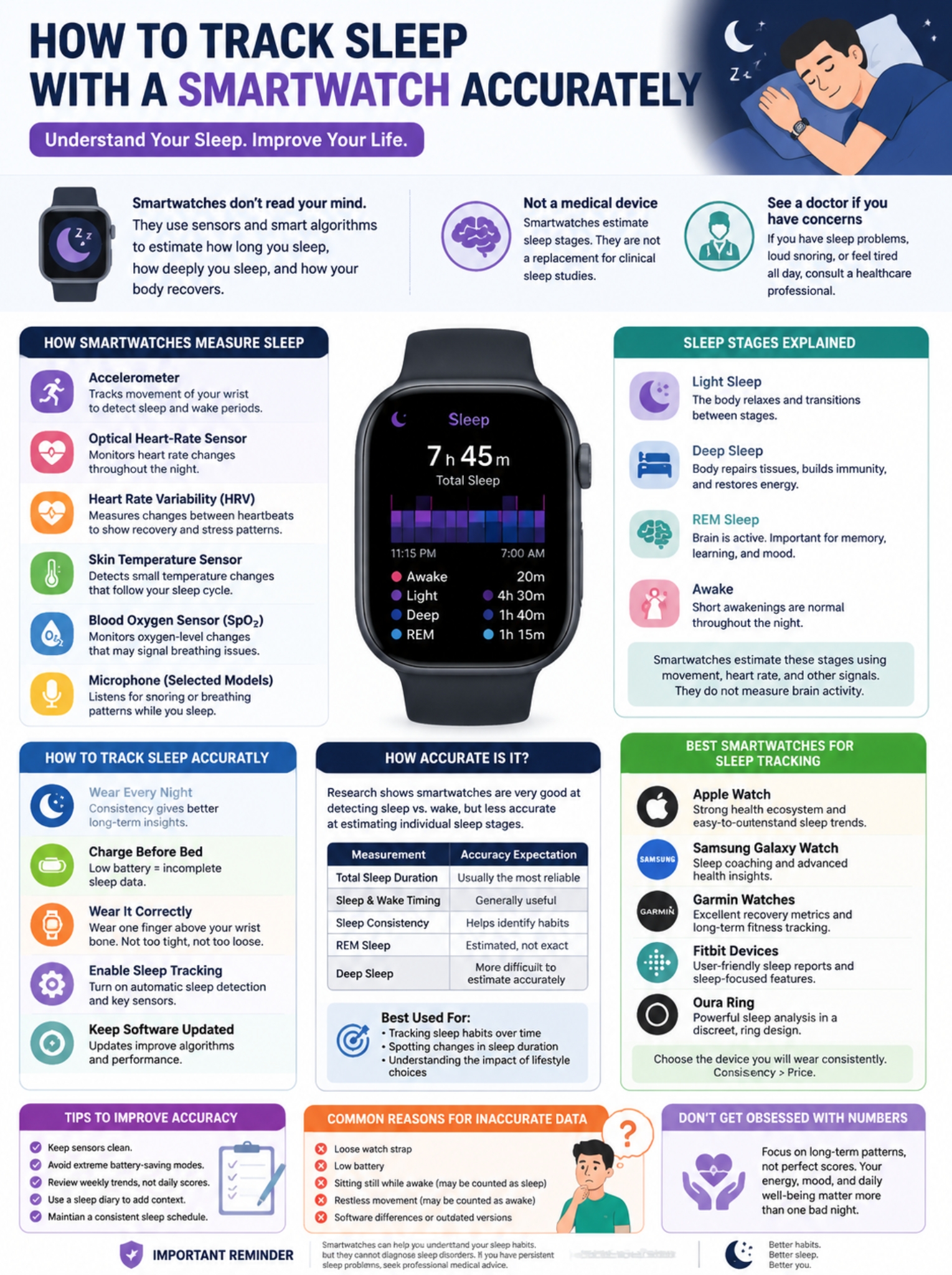
Numbers are helpful, but your daily experience matters too.
Ask yourself:
- Do I feel rested?
- Do I have enough energy during the day?
- Am I struggling to stay awake?
- Do I wake up frequently?
A smartwatch report and your personal experience should be considered together.
Can a Smartwatch Detect Sleep Problems?
Smartwatches can identify patterns that may deserve attention, but they cannot diagnose sleep disorders.
Some devices can track signals related to:
- Irregular breathing patterns
- Low oxygen levels
- Frequent awakenings
- Changes in sleep duration
However, these measurements are only indicators.
If you experience symptoms such as:
- Loud, regular snoring
- Gasping during sleep
- Frequent nighttime awakenings
- Extreme daytime tiredness
- Difficulty sleeping for long periods
it is better to speak with a healthcare professional.
A smartwatch can encourage you to ask questions, but diagnosis requires proper medical evaluation.
How Many Nights Should You Track Sleep Before Trusting the Data?
One night is rarely enough to understand your sleep pattern.
A practical approach:
|
Tracking Time |
What You Can Learn |
|
1–3 nights |
Basic information only |
|
1–2 weeks |
Early sleep habits and routines |
|
1 month |
More reliable patterns |
|
Several months |
Long-term changes |
The longer you track, the easier it becomes to separate normal variation from meaningful changes.
Should You Wear a Smartwatch Every Night?
For people who want sleep trends, wearing the device regularly provides better information.
However, comfort matters.
Some users find wearing a watch overnight uncomfortable. Others prefer taking occasional breaks.
There is no need to force yourself to wear a device if it affects your ability to sleep comfortably.
The goal is better sleep, not simply collecting more data.
Is Smartwatch Sleep Tracking Worth It?
For many people, yes.
A smartwatch can help you:
- Understand your sleep habits
- Notice changes over time
- Build healthier routines
- Connect lifestyle choices with sleep quality
But it works best when used as a guide rather than a judge.
The device can tell you what changed. It cannot always explain why.
Final Thoughts
Learning how to track sleep smartwatch data can help you understand your daily habits and make better decisions about your routine.
Modern smartwatches provide useful information about sleep duration, timing, and patterns. They can show whether your sleep habits are changing and help you connect lifestyle choices with your rest.
But the numbers are not perfect.
Sleep stages are estimates. Sleep scores vary between brands. A smartwatch cannot replace professional testing when there is a serious concern.
The best approach is simple:
- Wear your device consistently.
- Focus on long-term trends.
- Pay attention to how you feel.
- Use the data to build healthier habits.
A smartwatch is most valuable when it helps you understand your sleep — not when it makes you chase a perfect score.
Frequently Asked Questions About Smartwatch Sleep Tracking
Can a smartwatch accurately measure deep sleep?
Smartwatches can estimate deep sleep using movement, heart rate, and other signals, but they do not directly measure brain activity. Deep sleep estimates are generally less precise than total sleep duration measurements.
Should I wear my smartwatch on my dominant or non-dominant hand for sleep tracking?
Most manufacturers recommend wearing the watch on the wrist you normally use according to your device settings. Consistency matters more than choosing one specific hand.
If you switch wrists frequently, your data may become harder to compare.
Can a smartwatch detect sleep apnea?
Some smartwatches can identify signals that may be associated with breathing disturbances, such as oxygen-level changes or irregular breathing patterns. However, they cannot confirm a sleep apnea diagnosis.
A medical sleep evaluation is required for diagnosis.
Why does my smartwatch show different sleep stages every night?
Sleep naturally changes each night. Results may also vary because smartwatch algorithms estimate sleep stages using indirect signals.
Factors such as stress, exercise, illness, alcohol, and bedtime changes can influence your results.
How long should I use a smartwatch before analyzing my sleep habits?
A few weeks of consistent tracking usually provides a better picture than a few isolated nights. Longer periods help reveal meaningful patterns.