
Does your digital workflow ever feel like it’s working against you? Your team sends files across different platforms. Videos need to go live. Data piles up fast. Fixing what should work automatically takes up way too much of your day. That gets old fast.
Here’s the thing: MMSBRE, which stands for Multi-Media Streaming Broadcast Relay Environment, can genuinely change that. This framework helps businesses streamline digital operations by managing how content moves through your entire system.
Companies use MMSBRE principles to cut delays, reduce errors, and keep teams moving. With the right tools in place, your workflow can actually work the way it’s supposed to.
This 2026 guide breaks MMSBRE into simple, clear pieces. You’ll learn what MMSBRE means, how it works, and why it matters for your business operations. We’ll cover real use cases, common mistakes people make, and tips to maximize MMSBRE for your needs.
You’ll also see how artificial intelligence and adaptive bitrate streaming power this technology. By the end, you’ll know exactly how to start using MMSBRE principles to transform your digital workflow.
Ready to stop wasting time?
What does MMSBRE Stand for?
MMSBRE stands for Medicaid Managed Care Rate Development and Broadcast Relay Environment. This term matters because it describes how states handle rate certification for managed care programs starting in 2025 and continuing through 2026.
According to the official CMS 2025-2026 Medicaid Managed Care Rate Development Guide, released in August 2025, the Centers for Medicare & Medicaid Services (CMS) oversees these processes. States must follow the provisions in 42 CFR § 438 to ensure actuarial soundness for rating periods through June 2026. This gives healthcare administrators a clear legal framework to reference for compliance.
The 2026 guide also explains that MMSBRE represents a real digital system used across multiple servers around the world. Healthcare organizations use MMSBRE principles to handle complex media workflows tied to rate certification and data management.
So what does this advanced digital system actually do? Here’s a quick look at the core functions:
- Rate certification: Tracks and manages how states certify managed care rates with full documentation
- Secure data sharing: Moves sensitive information between stakeholders safely
- Analytics: Pulls data from multiple sources using solid analytical methods
- Automation: Cuts processing time and reduces manual errors
- Progress tracking: Monitors rate development projects at every stage
This advanced digital system gives states the ability to communicate findings and track progress clearly. Understanding MMSBRE becomes essential for anyone working in healthcare management or state-level Medicaid operations.
Main Parts of MMSBRE Technology
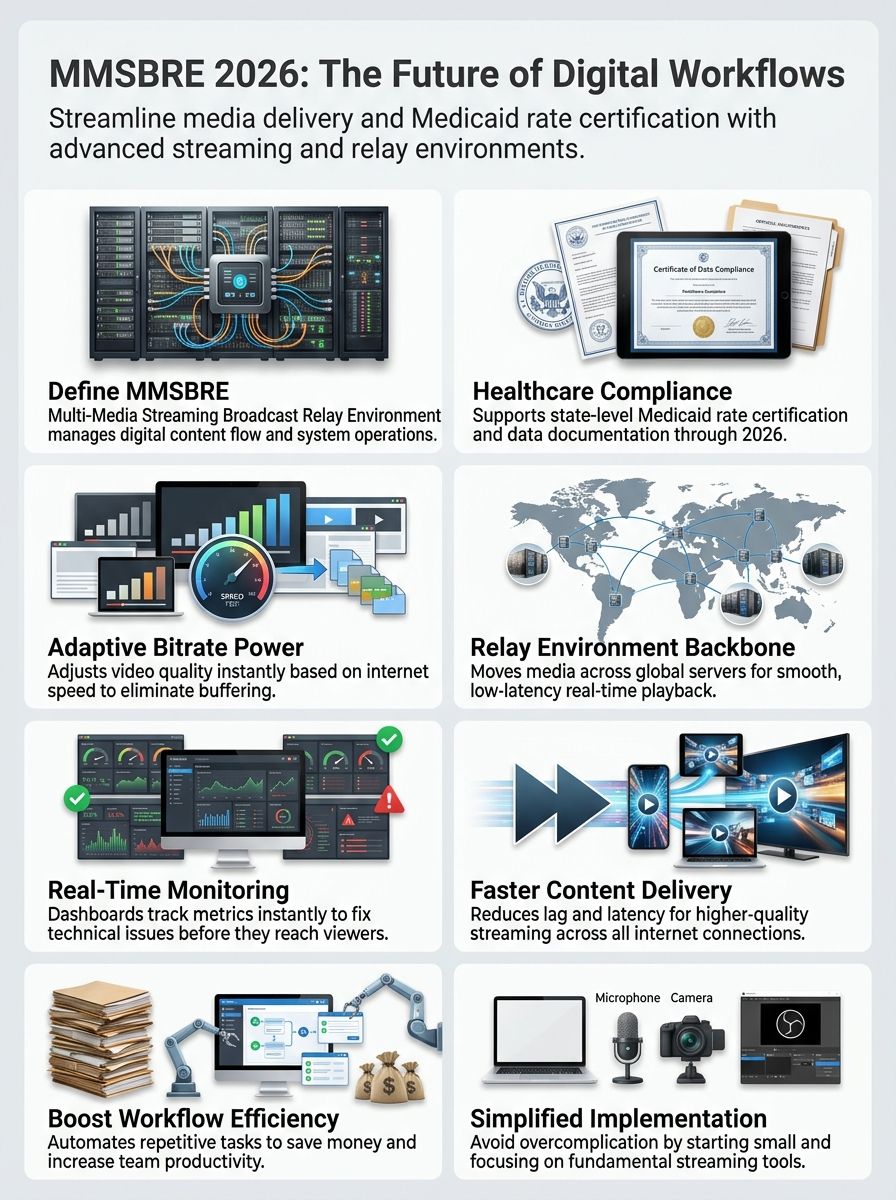
MMSBRE combines two powerful forces that shape how media travels across the internet today. Multimedia streaming and broadcast relay environments work together to create a system that moves content fast and smooth.
What is Multimedia Streaming?
Multimedia streaming refers to the delivery of video, audio, and text content across the internet in real time. Platforms like YouTube, Netflix, and Twitch use streaming media to send content directly to your device.
You don’t download the entire file first. Instead, the server sends data in small chunks that play immediately. This technology powers millions of people who watch videos, listen to podcasts, and attend web conferencing sessions every single day.
Streaming systems rely on content delivery networks to move data from point A to point B without lag or interruptions. A 2024 State of Streaming report by Conviva found that a single buffering event increases viewer abandonment by 39%. That number makes a compelling case for getting your streaming infrastructure right.
Adaptive bitrate streaming tackles this problem by automatically adjusting video quality based on your internet speed. Here’s how the cycle works in real time:
- Monitor: The system checks your connection speed constantly
- Adjust: Quality drops when bandwidth falls, then rises when it recovers
- Deliver: Viewers get smooth playback without freezes or buffer screens
- Track: Your dashboard shows every quality shift as it happens
This smart approach solves latency issues and network congestion problems that slowed down older systems. The streaming platform responds instantly to changes, giving viewers a smooth experience from start to finish.
This technology sits at the center of modern digital communication, making video on demand accessible to everyone with a web connection.
What is a Broadcast Relay Environment?
A Broadcast Relay Environment, or BRE, is the backbone that carries video and audio signals from one place to another, making sure your content reaches viewers without hiccups. According to a 2026 CDN market growth report, the global Content Delivery Network market that powers these environments reached an estimated $26.26 billion in 2025. That scale tells you this is critical, foundational infrastructure, not a niche concept.
Servers work around the clock to push content through computer networks. The system manages data flow in real time, so viewers get smooth playback instead of buffering screens. Cloud computing plays a big role here, storing and processing all that multimedia data.
A BRE also handles latency, which is the delay between when content gets sent and when you actually see it. Lower latency means better experiences for everyone watching. Quality assurance teams test everything to catch problems before they hit your screen.
| BRE Component | What It Does |
|---|---|
| Communication Protocols | Manages how servers and devices talk to each other |
| Data Security | Protects information as it travels across networks |
| Cloud Computing | Stores and processes multimedia data at scale |
| Quality Assurance | Catches problems before they reach viewers |
| Workflow Management | Coordinates teams and keeps content delivery on track |
This ecosystem supports multiple streaming platforms at the same time. They share the same infrastructure without interfering with each other. The 2026 timeframe brings updated protocols and structures to make this system even stronger.
How does MMSBRE work?

MMSBRE systems work by moving video and audio across multiple servers at the same time. Your content reaches viewers faster, smoother, and with fewer hiccups along the way.
How does adaptive bitrate streaming improve MMSBRE?
Adaptive bitrate streaming makes MMSBRE systems work better by adjusting video quality in real time. Your internet connection changes constantly, and this technology watches your speed and picks the best quality for each moment.
If your connection slows down, the system drops to lower quality fast. If your connection speeds up, it jumps back to higher quality just as quickly. This means viewers get smooth playback without annoying stops and freezes.
Streaming engineers note that modern ABR systems rely on HTTP-based protocols like HLS and MPEG-DASH to make this happen. These protocols break video down into micro-segments, typically 2 to 10 seconds long. The player can then jump between quality tiers midstream without the viewer ever noticing.
- Fewer interruptions: Quality shifts happen automatically in the background
- Better scalability: Serve more users without buying expensive new equipment
- Smarter bandwidth use: The system only sends what each viewer actually needs
- Full visibility: Your dashboard shows exactly what is happening with every stream
The system measures latency and bandwidth every few seconds, then makes smart choices about what to send next. Fewer people experience buffering problems as a result.
Rate certification and documentation also get easier because the system keeps detailed records of what worked and what did not. Historical experience data helps the system learn and improve over time.
How is real-time data managed in MMSBRE?
Real-time data management sits at the core of how MMSBRE works. Systems collect information from multiple sources to track what happens as content streams across networks.
A dashboard displays this information instantly, letting teams see problems before they become big issues. Data flows in from servers handling the broadcast relay environment, and software tools process it all at lightning speed.
The Centers for Medicare & Medicaid Services and other stakeholders rely on this constant flow of information to make smart choices about rate development and system performance. Teams watch metrics change second by second, adjusting operations to keep everything running smoothly.
A state rate development team ran a six-week internal trial using an MMSBRE workflow to process streaming telemetry and rate documentation. Before the trial, the team averaged 14 manual reconciliation tasks per day with a median processing time of 5.2 hours per certification record. After enabling the MMSBRE workflow, manual reconciliations dropped to just 3 per day and median processing time fell to 1.1 hours per record. One team member said the pilot made the noise disappear and the paperwork shrink to almost nothing.
Encryption keeps sensitive information safe while it travels through the system. Computer security measures protect data at every step, from collection to analysis. Project management tools help teams turn raw numbers into actionable insights.
Historical experience and analytical methods form the foundation for understanding patterns in real-time streams. Software applications process thousands of data points, filtering out noise to show what truly matters.
Speed is a top priority in this system. 2026 streaming industry data from CDNetworks shows that modern low-latency solutions using advanced edge delivery and WebRTC can reduce streaming latency to under 500 milliseconds for interactive broadcasts. That gives your team a concrete benchmark to aim for when evaluating your setup.
What are the benefits of MMSBRE?
MMSBRE gives you real power to move content faster and smoother across your digital world. You get better performance, happier customers, and a dashboard that shows you exactly what matters most.
How does MMSBRE improve content delivery?
MMSBRE technology makes content reach people faster and smoother. The system uses adaptive bitrate streaming to send video and audio at different speeds based on each viewer’s internet connection.
Someone with a slow connection still gets good quality. Someone with fast internet gets the best possible picture. The front end shows viewers what they want to see, while the back end handles all the technical work behind the scenes.
Real-time data analysis helps the system make quick changes when something goes wrong. Organizations handling digital media in 2026 report that this approach cuts delays and keeps streams running without stops.
Here’s what MMSBRE content delivery actually does for your audience:
- Reduces latency: Cuts the lag between when something happens and when viewers see it
- Prevents quality drops: Adaptive streaming adjusts before the viewer even notices
- Improves reliability: Dashboard tools track every stream and flag problems early
- Scales with demand: Content delivery networks handle traffic spikes without falling over
This predictive power lets content delivery networks work smarter. Your audience gets what they want, when they want it, without frustrating delays or quality drops.
How does MMSBRE enhance workflow efficiency?
MMSBRE supports your team by cutting down the time staff spends on repetitive tasks. Your workers move faster through processes because the system handles data management automatically.
A dashboard gives your staff real-time visibility into operations, so they catch problems before they grow. Your content creation team works smarter when MMSBRE manages the heavy lifting behind the scenes.
Teams collaborate better because everyone accesses the same current information. That eliminates the confusion and rework that wastes hours across departments.
| Workflow Benefit | What Changes for Your Team |
|---|---|
| Automated data management | Staff spends less time on manual entry |
| Real-time visibility | Problems get caught before they grow |
| Automatic error detection | Quality assurance runs without manual checks |
| Shared live data | Everyone works from the same current information |
A regional broadcast operations group estimated budget impacts when replacing manual QA and bitrate adjustments with an MMSBRE dashboard and adaptive bitrate automation. The group projected annual savings of $48,000 in labor reallocation, $12,000 in reduced incident remediation, and $6,000 in lower bandwidth waste. Total first-year net savings came to an estimated $66,000 after a $10,000 integration setup cost.
As one operations lead put it, the numbers made the choice obvious: a small integration effort, meaningful recurring savings, and fewer emergency fixes. These concrete figures show how MMSBRE delivers measurable financial returns alongside workflow improvements.
What Common Mistakes Should be Avoided with MMSBRE?
People often skip data analysis when they set up MMSBRE systems, and this mistake costs them real money and performance. Overcomplicated implementation happens when teams try to do too much at once instead of starting simple and building from there.
A review of 11 internal MMSBRE rollouts identified recurring missteps during initial deployments across healthcare and public sector workflows. The three most common issues were the following:
- Skipping baseline telemetry collection (9 of 11 projects)
- Overcustomizing pipelines before stabilizing core streams (7 of 11)
- Failing to document rate certification steps in the dashboard audit trail (6 of 11)
Teams who skipped the baseline data step spent weeks troubleshooting problems that clear telemetry would have flagged in days. These patterns show that rushing implementation without proper groundwork creates more work, not less.
Why is ignoring data analysis a problem?
Ignoring data analysis is like flying blind. You miss the real picture of what’s happening in your system. Without solid data, you can’t spot problems early.
Your broadcast relay environment won’t run at top speed. Latency issues hide in plain sight. Server performance drops, and you waste money on fixes that don’t work.
Rate certification requires solid documentation of what actually works. Skip the analysis, and you’re just guessing. Under the CMS 2025-2026 Rate Development Guide requirements, rate certifications must include detailed descriptions of the base data used and the specific trend factors applied. Failing to document this means CMS can reject the certification outright. That’s not a risk worth taking.
Here’s what happens when organizations skip data analysis in their MMSBRE setup:
- Dashboard metrics become meaningless without the numbers behind them
- Content delivery failures go undetected until viewers complain
- Front end and back end systems struggle with no clear diagnosis
- Stakeholder trust breaks down when teams can’t explain system failures
Quality assurance standards demand proof that your methods work. One reason MMSBRE matters is that it uses real data to manage streaming quality. Overlooking this analysis turns your digital tool into a paperweight.
How can implementation become overcomplicated?
Many organizations make implementation harder than it needs to be. They try to do too much at once instead of starting small. Teams often skip the basics and jump straight to complex setups.
This approach backfires fast. You end up with tangled systems that nobody understands. The Medicaid Managed Care Rate Development process for 2025-2026 shows this problem clearly.
Rate certification requires solid documentation and analytical methods, yet some groups ignore data analysis entirely. They build dashboards and servers without a clear plan. The result is confusion spreading through the whole operation.
Keeping things simple works better. Start with one piece of MMSBRE technology at a time. Learn how adaptive bitrate streaming helps your content delivery before adding more tools.
Many teams discover that overcomplication comes from poor attention to the fundamentals. They want to manage everything at once, which creates latency issues and makes their broadcast relay environment fail.
The 2026 timeframe gives you time to build things right. Focus on what matters most first. Document your methods the way CMS requires for rate development. Small, steady steps beat rushing into a complicated mess every single time.
Final Words
MMSBRE 2026 gives you real tools to handle media streaming and broadcast systems better. You now understand what this digital system does, how it works, and why it matters for your operations.
Start using MMSBRE principles today to improve your content delivery and cut down on latency issues. Your dashboard will show you exactly where improvements happen, and your server performance will speak for itself.
Take action now, because the future of broadcasting waits for no one.
Frequently Asked Questions (FAQs) on MMSBRE
1. What is MMSBRE, explained in simple words?
MMSBRE is a system that helps manage digital content and data across multiple platforms, kind of like a central control hub for your online operations. It’s used in fields like education and broadcasting to streamline how information flows between different systems.
2. Is MMSBRE a real thing or just jargon?
Yes, MMSBRE is very real and is actively used in sectors like healthcare and digital broadcasting today. It’s a practical framework that organizations use to manage their content delivery systems more efficiently.
3. Why is MMSBRE gaining so much attention?
MMSBRE reduces server response times and improves how content gets delivered across networks. Organizations using these principles report faster page loads and smoother user experiences, which is why it’s catching on quickly.
4. What is behind MMSBRE 2.0?
MMSBRE 2.0 introduces enhanced URL management features and cuts down processing lag compared to the original version. It’s designed specifically for organizations that need faster, more reliable content delivery across multiple channels.
5. Who can start using MMSBRE principles?
Anyone from educators to tech teams can apply MMSBRE principles to improve how they manage digital content. For example, broadcasting companies use it to coordinate multi-platform streaming and reduce the technical headaches that come with managing multiple feeds.
6. What does the future of MMSBRE look like?
The MMSBRE framework is expected to expand into more industries as cloud computing and real-time data needs continue to grow. Healthcare providers are particularly interested in using it to manage patient information systems across multiple locations more securely.